A practical framework for evaluating access, document retention, payroll workflows, and vendor accountability. This guide is written for a growing U.S. employer moving from disconnected spreadsheets to integrated HR and payroll systems. It explains the tradeoffs a buyer can check without treating sales claims, product popularity, or advertising promises as independent evidence.
The challenge is to make controls usable in real work: staff need an accountable method, not a promise that a vendor will solve every problem automatically. For this subject, the central decision is specific: Sensitive employee records require clear process ownership; a simple self-service portal is not enough. The examples below are illustrative exercises, not claims that any named supplier has failed or passed an audit. Features, prices, data processing terms, and plan availability can change; verify the actual service before purchasing.
Begin with a decision the organization can defend
Consider the following representative situation: A growing U.S. employer moving from disconnected spreadsheets to integrated HR and payroll systems. A selection meeting will be more useful if it establishes owners, measurable acceptance criteria, and the information the chosen service must protect. A product demonstration is a starting point for asking better questions; it should not replace a documented trial, a contract review, or a defined recovery route.
Sensitive employee records require clear process ownership; a simple self-service portal is not enough. Put this sentence at the top of the evaluation worksheet and ask each stakeholder to state which evidence would change their recommendation. That exercise prevents a conversation about attractive features from displacing practical questions about data handling, team adoption, business continuity, and responsibilities after launch.
Eight issues to evaluate in depth
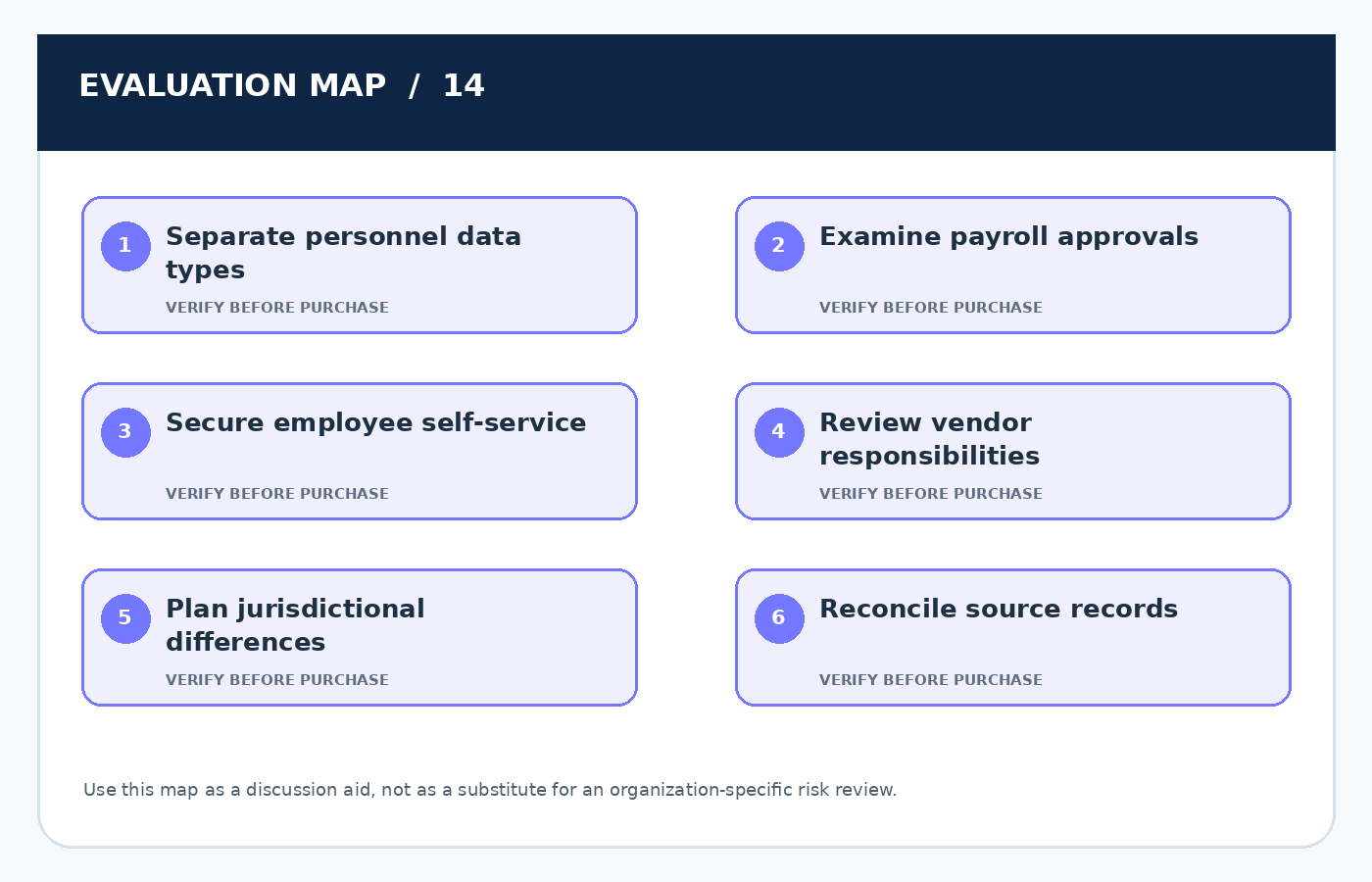
1. Separate personnel data types
Pay information, tax forms, identity documents, benefits details, performance notes, and accommodation records have different audiences and handling requirements.
Failure to anticipate: A shared document repository may accidentally make confidential personnel material visible to managers who only need approval access for time off.
Evidence to request: Create a record classification chart and map approved readers, storage locations, retention requirements, and export permissions for each type.
2. Examine payroll approvals
Pay-rate changes, bank-detail edits, off-cycle runs, and employee termination should have accountable authorization and review.
Failure to anticipate: A compromised HR login can be especially harmful if one person can edit destination accounts and approve disbursement without a second check.
Evidence to request: Rehearse fictional pay and bank changes, verify approval separation, review logging, and confirm how emergency corrections are documented.
3. Secure employee self-service
Staff need convenient access to their own records without browsing another employee's information or exposing recovery routes.
Failure to anticipate: Weak account recovery or shared kiosk sessions can undermine otherwise restricted payroll roles and create privacy incidents in ordinary workplaces.
Evidence to request: Test employee separation, MFA options, device/session behavior, identity verification for changes, and offboarding from the portal.
4. Review vendor responsibilities
Payroll providers may rely on processing partners for direct deposits, taxes, identity verification, benefits enrollment, or document delivery.
Failure to anticipate: A buyer may assume the primary vendor handles every subcontractor and security incident when contractual terms actually allocate duties differently.
Evidence to request: Ask for processor information, service boundaries, incident reporting terms, and a clear matrix of customer-versus-vendor tasks.
5. Plan jurisdictional differences
Employee document rules and retention obligations can vary across federal, state, and local laws and by employment arrangement.
Failure to anticipate: A single global deletion setting or a software advertisement should not be treated as authoritative legal advice for every workforce location.
Evidence to request: Involve payroll professionals and counsel where appropriate, document applicable rules, and ensure the platform can implement approved retention schedules.
6. Reconcile source records
Time tracking, leave approval, commissions, and expense reimbursement may arrive from separate systems with different timing and definitions.
Failure to anticipate: Automated payroll imports can compound an incorrect sales commission mapping or duplicate a time entry if retries are not idempotent.
Evidence to request: Test representative transactions, reconcile exception reports, and establish who signs off before financial processing is released.
7. Assess resilience and support
Delayed payroll can harm employees quickly, so contingency procedures should be realistic even when a cloud vendor promises high availability.
Failure to anticipate: If only one administrator knows how to contact urgent support or obtain export files, routine leave or a supplier outage becomes a payment risk.
Evidence to request: Document escalation numbers, authorized backups, manual contingency steps, and recovery objectives tied to the pay calendar.
8. Audit recurring access
Personnel change rapidly as staff join, transfer departments, become managers, or leave; privileged access should not drift indefinitely.
Failure to anticipate: Former finance contractors may retain report subscriptions or exported employee files after their interactive login is disabled.
Evidence to request: Review roles, active sessions, integrations, downloaded reports, and delegated access on a recurring schedule.
Procurement questions worth writing down
These questions translate the operational discussion into a decision record. Do not send them as an unexplained survey; ask the supplier to demonstrate answers in the actual subscription tier and have the business owner confirm the evidence.
- Separate personnel data types: Can the organization retrieve the relevant information and relationships in a usable format if it changes supplier?
- Examine payroll approvals: Which feature depends on another product or subprocessor, and how will material changes be communicated to the customer?
- Secure employee self-service: What task would staff complete during a vendor outage or a permission-related lockout?
- Review vendor responsibilities: Which exact records, identities, or business events are within this requirement, and what is deliberately out of scope?
- Plan jurisdictional differences: Can the proposed capability be demonstrated with a fictional but realistic operating example rather than an idealized vendor dataset?
- Reconcile source records: Who approves an exception, which evidence is retained, and what event triggers a review or revocation?
- Assess resilience and support: What additional edition, storage, implementation, or integration cost is required to make the promised capability operational?
- Audit recurring access: How would an employee notice that the control failed, and who is accountable for containment and correction?
A realistic 90-day adoption plan
First 30 days: reconcile source records
Document the current workflow, existing software spend, role ownership, and the failure that motivated the purchase. Establish baseline measurements and an information classification before introducing a new subscription or connecting production accounts. The focused activity in this phase concerns reconcile source records; use an approved test record and retain the outcome for the rollout decision.
The checkpoint should include the decision owner, a clear pass-or-fail observation, and an agreed route to fix any unresolved issue. A planned launch date alone is not an acceptance criterion.
Days 31–60: separate personnel data types
Pilot a representative process with fictional records, compare practical task completion with the incumbent method, and test the main exception paths. Capture the true cost of the required edition, integrations, training, and recurring internal administration. The focused activity in this phase concerns separate personnel data types; use an approved test record and retain the outcome for the rollout decision.
The checkpoint should include the decision owner, a clear pass-or-fail observation, and an agreed route to fix any unresolved issue. A planned launch date alone is not an acceptance criterion.
Days 61–90: review vendor responsibilities
Adopt the process gradually, reconcile records and outputs, and assign both an operational owner and an escalation backup. Review costs, access, performance, and recoverability against the written objectives before committing to broader rollout. The focused activity in this phase concerns review vendor responsibilities; use an approved test record and retain the outcome for the rollout decision.
The checkpoint should include the decision owner, a clear pass-or-fail observation, and an agreed route to fix any unresolved issue. A planned launch date alone is not an acceptance criterion.
Frequently asked buyer questions
What should we validate before paying for a solution related to separate personnel data types?
Test a small, representative process with fictional records and obtain a written explanation of the service boundaries. The aim is to understand the exact purchased capability, the conditions under which it works, and whether it can be monitored by the customer after launch.
Which hidden risk tends to be overlooked in secure employee self-service?
The most common evaluation gap is treating the expected operating path as the only possible outcome. Include a negative test, agree on what a failure looks like, and name the individual who will investigate the exception rather than letting a supplier treat it as an edge case.
How can a small team conduct a meaningful trial without a large budget?
Concentrate on one workflow, a limited set of synthetic records, and staff who perform the job. A short, documented trial often produces better evidence than an extensive feature tour with no agreed success criteria. Protect sample information and document what would justify purchasing the next tier.
When should we reconsider the original buying decision?
Reopen the evaluation when the service boundary, pricing, team structure, data sensitivity, or business process changes significantly. Good stewardship is ongoing: the original procurement decision is not permanent authorization for every later use. Reassess unresolved risks and test that transition rights still work.
Official resources and further reading
These sources provide background principles and guidance. They do not endorse the fictional scenarios or certify a vendor mentioned in this article.
- FTC Cybersecurity for Small Business
- NIST CSF 2.0 Small Business Quick-Start Guide
- FTC Data Breach Response: A Guide for Business
Editorial conclusion
The right answer depends on workload, the value and sensitivity of the records, internal capacity, and the precise service terms. For payroll and hr software: how to protect employee records, a defensible decision follows from the checks above and from an honest discussion of what cannot yet be demonstrated. Make unresolved questions visible, preserve a practical exit path, and recheck assumptions after the system becomes part of day-to-day work.
Related Posts
Help Desk Software and CRM: Building a Responsible Customer Support Stack
How to connect customer service, contact history, escalation, and reporting…
The Small-Business Cybersecurity Software Stack: What to Buy First
A measured spending guide for identity protection, endpoint management, backups,…
The True Cost of SaaS: Building a 24-Month Software Budget
A financial model that accounts for implementation, licensing, integrations, adoption,…