How to evaluate task visibility, guest access, document collaboration, automation, and the work required for adoption. This guide is written for a professional-services agency managing customer projects with employees and freelancers. It explains the tradeoffs a buyer can check without treating sales claims, product popularity, or advertising promises as independent evidence.
Better buying decisions emerge when operational requirements are written down before teams compare product tiers or agree to an implementation timeline. For this subject, the central decision is specific: Assess collaboration boundaries as seriously as dashboards and scheduling features. The examples below are illustrative exercises, not claims that any named supplier has failed or passed an audit. Features, prices, data processing terms, and plan availability can change; verify the actual service before purchasing.
Begin with a decision the organization can defend
Consider the following representative situation: A professional-services agency managing customer projects with employees and freelancers. A selection meeting will be more useful if it establishes owners, measurable acceptance criteria, and the information the chosen service must protect. A product demonstration is a starting point for asking better questions; it should not replace a documented trial, a contract review, or a defined recovery route.
Assess collaboration boundaries as seriously as dashboards and scheduling features. Put this sentence at the top of the evaluation worksheet and ask each stakeholder to state which evidence would change their recommendation. That exercise prevents a conversation about attractive features from displacing practical questions about data handling, team adoption, business continuity, and responsibilities after launch.
Eight issues to evaluate in depth
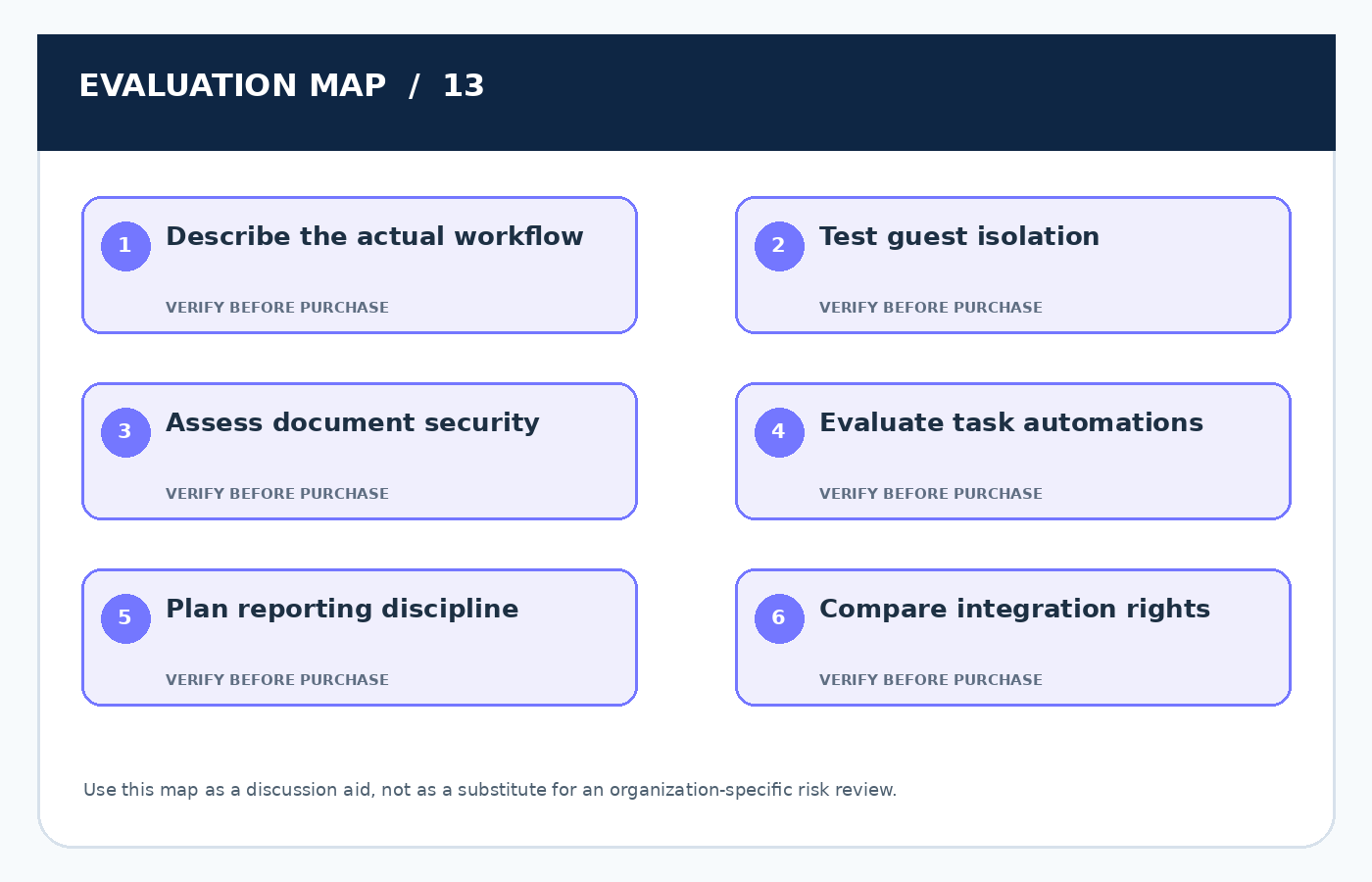
1. Describe the actual workflow
Inventory how work moves from intake through approvals, assignments, client review, and final delivery before comparing dozens of product features.
Failure to anticipate: Teams sometimes buy a sophisticated timeline tool when their main problem is unclear task ownership and inconsistent change approval.
Evidence to request: Recreate one representative project with milestones, dependencies, client comments, and a change request in trial workspaces.
2. Test guest isolation
External clients and contractors may need selected tasks or files without gaining visibility into internal budgets or other customers' accounts.
Failure to anticipate: A workspace-wide invitation can accidentally reveal names, documents, or discussion history from unrelated projects.
Evidence to request: Create separate fictional client projects and verify what guests can discover through search, notifications, mobile apps, and exports.
3. Assess document security
Task attachments can include contracts, credentials, quotations, and personnel information subject to different sharing and retention expectations.
Failure to anticipate: A file's permissions may differ from its enclosing task, particularly after integrations or public-share links are enabled.
Evidence to request: Check inherited permissions, link expiration, version history, deletion behavior, and whether download restrictions meet genuine business needs.
4. Evaluate task automations
Automatic assignments, reminders, and cross-board moves can eliminate repetitive work but may act on incomplete or incorrect status data.
Failure to anticipate: A trigger configured by an enthusiastic user can email a client before internal quality review or close tasks that require a second approval.
Evidence to request: Pilot triggers with synthetic projects, include rollback and exception handling, and document who can create or edit shared automations.
5. Plan reporting discipline
Utilization, workload, overdue tasks, and project margin require consistent definitions across teams and a policy for status updates.
Failure to anticipate: Bright executive charts can hide stale tasks, inconsistent estimates, or missing contractor time if underlying inputs are not maintained.
Evidence to request: Define a weekly hygiene review and compare dashboard numbers with manually sampled projects before relying on them for staffing decisions.
6. Compare integration rights
Calendar, chat, repository, and CRM connections may broaden access to project data outside its original sharing boundary.
Failure to anticipate: A convenient two-way sync could expose an internal task description in a customer-facing calendar or shared messaging channel.
Evidence to request: Review connector scopes, field selection, notification targets, ownership, and failure alerts for each planned integration.
7. Account for adoption costs
Rollout includes information architecture, templates, training, project migration, and habits for every team that uses the tool.
Failure to anticipate: Buying the longest feature list rarely compensates for a workflow staff consider too cumbersome to update after a busy client call.
Evidence to request: Run short usability tests, measure time to create and find tasks, and give teams a limited set of approved templates.
8. Write an exit plan
Projects may need to remain auditable after completion, with comments, attachments, dates, dependencies, and sign-offs intact.
Failure to anticipate: A basic CSV export can preserve task names yet omit essential context or file links needed for contracts and ongoing service.
Evidence to request: Request export samples and archive requirements before procurement, then simulate rebuilding one project outside the vendor interface.
Procurement questions worth writing down
These questions translate the operational discussion into a decision record. Do not send them as an unexplained survey; ask the supplier to demonstrate answers in the actual subscription tier and have the business owner confirm the evidence.
- Describe the actual workflow: How would an employee notice that the control failed, and who is accountable for containment and correction?
- Test guest isolation: Can the organization retrieve the relevant information and relationships in a usable format if it changes supplier?
- Assess document security: Which feature depends on another product or subprocessor, and how will material changes be communicated to the customer?
- Evaluate task automations: What task would staff complete during a vendor outage or a permission-related lockout?
- Plan reporting discipline: Which exact records, identities, or business events are within this requirement, and what is deliberately out of scope?
- Compare integration rights: Can the proposed capability be demonstrated with a fictional but realistic operating example rather than an idealized vendor dataset?
- Account for adoption costs: Who approves an exception, which evidence is retained, and what event triggers a review or revocation?
- Write an exit plan: What additional edition, storage, implementation, or integration cost is required to make the promised capability operational?
A realistic 90-day adoption plan
First 30 days: plan reporting discipline
Document the current workflow, existing software spend, role ownership, and the failure that motivated the purchase. Establish baseline measurements and an information classification before introducing a new subscription or connecting production accounts. The focused activity in this phase concerns plan reporting discipline; use an approved test record and retain the outcome for the rollout decision.
The checkpoint should include the decision owner, a clear pass-or-fail observation, and an agreed route to fix any unresolved issue. A planned launch date alone is not an acceptance criterion.
Days 31–60: write an exit plan
Pilot a representative process with fictional records, compare practical task completion with the incumbent method, and test the main exception paths. Capture the true cost of the required edition, integrations, training, and recurring internal administration. The focused activity in this phase concerns write an exit plan; use an approved test record and retain the outcome for the rollout decision.
The checkpoint should include the decision owner, a clear pass-or-fail observation, and an agreed route to fix any unresolved issue. A planned launch date alone is not an acceptance criterion.
Days 61–90: assess document security
Adopt the process gradually, reconcile records and outputs, and assign both an operational owner and an escalation backup. Review costs, access, performance, and recoverability against the written objectives before committing to broader rollout. The focused activity in this phase concerns assess document security; use an approved test record and retain the outcome for the rollout decision.
The checkpoint should include the decision owner, a clear pass-or-fail observation, and an agreed route to fix any unresolved issue. A planned launch date alone is not an acceptance criterion.
Frequently asked buyer questions
What should we validate before paying for a solution related to describe the actual workflow?
Test a small, representative process with fictional records and obtain a written explanation of the service boundaries. The aim is to understand the exact purchased capability, the conditions under which it works, and whether it can be monitored by the customer after launch.
Which hidden risk tends to be overlooked in assess document security?
The most common evaluation gap is treating the expected operating path as the only possible outcome. Include a negative test, agree on what a failure looks like, and name the individual who will investigate the exception rather than letting a supplier treat it as an edge case.
How can a small team conduct a meaningful trial without a large budget?
Concentrate on one workflow, a limited set of synthetic records, and staff who perform the job. A short, documented trial often produces better evidence than an extensive feature tour with no agreed success criteria. Protect sample information and document what would justify purchasing the next tier.
When should we reconsider the original buying decision?
Reopen the evaluation when the service boundary, pricing, team structure, data sensitivity, or business process changes significantly. Good stewardship is ongoing: the original procurement decision is not permanent authorization for every later use. Reassess unresolved risks and test that transition rights still work.
Official resources and further reading
These sources provide background principles and guidance. They do not endorse the fictional scenarios or certify a vendor mentioned in this article.
- FTC Cybersecurity for Small Business
- NIST CSF 2.0 Small Business Quick-Start Guide
- Microsoft Dataverse: Role-Based Security
Editorial conclusion
The right answer depends on workload, the value and sensitivity of the records, internal capacity, and the precise service terms. For project management software for smbs: a security-first buying guide, a defensible decision follows from the checks above and from an honest discussion of what cannot yet be demonstrated. Make unresolved questions visible, preserve a practical exit path, and recheck assumptions after the system becomes part of day-to-day work.
Related Posts
Cloud File Sharing for Businesses: Comparing Collaboration and Control
A decision framework for document collaboration that includes external sharing,…
No-Code Business Automation: Governance Without Slowing Teams
A practical way to keep low-code workflows useful, auditable, and…
Choosing Accounting Software That Integrates Safely With Your CRM
A buyer’s guide to connecting quotes, customers, invoices, and payment…