A sober measurement framework for software investments that includes adoption, quality, operating cost, and customer impact. This guide is written for a business leader defending a SaaS renewal with evidence rather than vendor-generated benefit estimates. It explains the tradeoffs a buyer can check without treating sales claims, product popularity, or advertising promises as independent evidence.
Before adding another subscription, identify the decisions, records, and people affected by the proposed software change. For this subject, the central decision is specific: Measure a defined workflow before and after rollout, with assumptions visible and uncertainty acknowledged. The examples below are illustrative exercises, not claims that any named supplier has failed or passed an audit. Features, prices, data processing terms, and plan availability can change; verify the actual service before purchasing.
Begin with a decision the organization can defend
Consider the following representative situation: A business leader defending a SaaS renewal with evidence rather than vendor-generated benefit estimates. A selection meeting will be more useful if it establishes owners, measurable acceptance criteria, and the information the chosen service must protect. A product demonstration is a starting point for asking better questions; it should not replace a documented trial, a contract review, or a defined recovery route.
Measure a defined workflow before and after rollout, with assumptions visible and uncertainty acknowledged. Put this sentence at the top of the evaluation worksheet and ask each stakeholder to state which evidence would change their recommendation. That exercise prevents a conversation about attractive features from displacing practical questions about data handling, team adoption, business continuity, and responsibilities after launch.
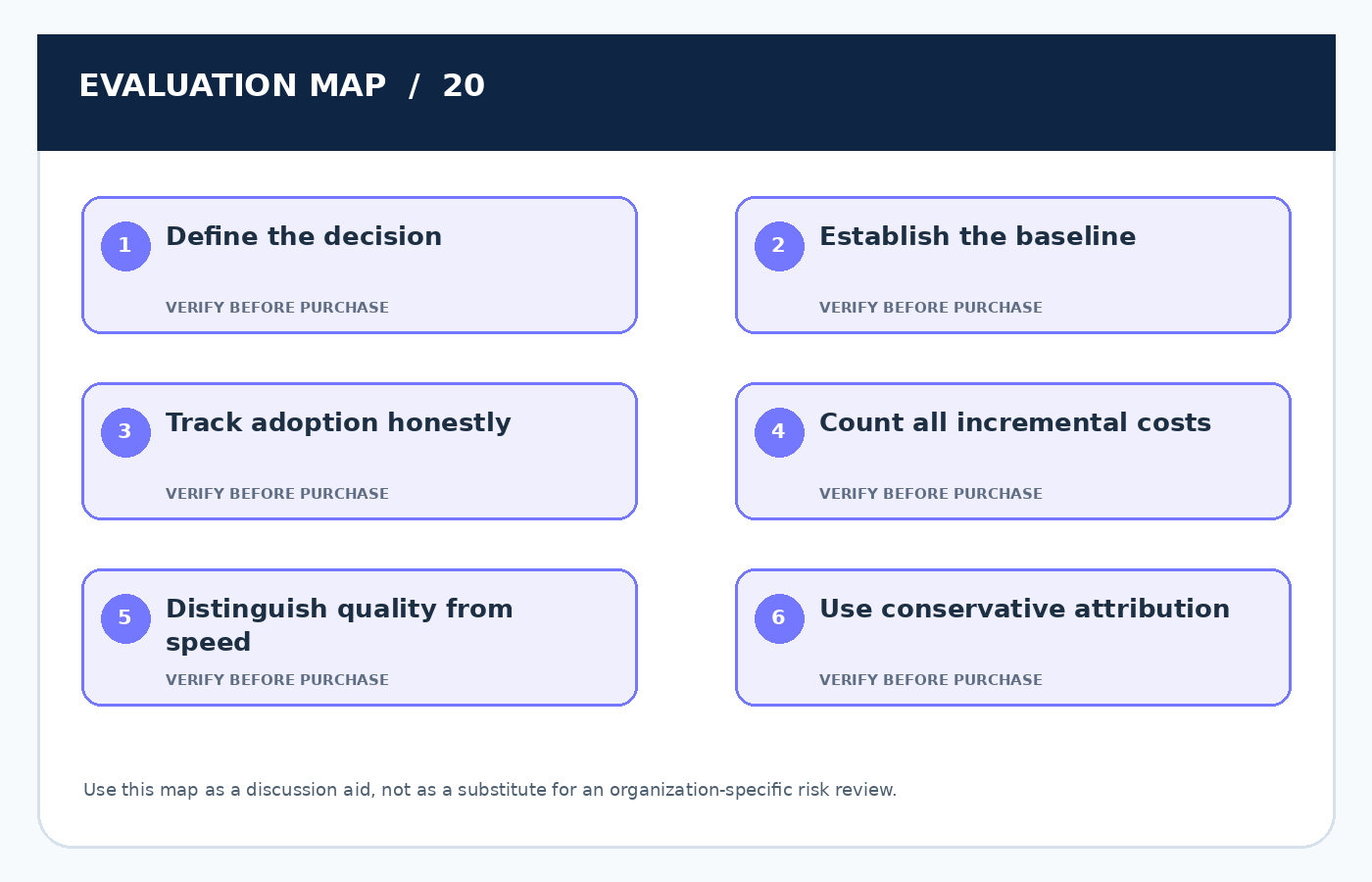
Eight issues to evaluate in depth
1. Define the decision
Decide whether the investment aims to reduce manual effort, improve response quality, strengthen control, increase capacity, or support a new revenue workflow.
Failure to anticipate: An all-purpose ROI claim encourages analysts to count unrelated benefits and ignore the activity the product was actually purchased to improve.
Evidence to request: Write one decision statement and choose a small number of metrics directly attributable to the affected process.
2. Establish the baseline
Record current task volume, elapsed time, staff hours, error frequency, and any meaningful differences between customer segments or busy periods.
Failure to anticipate: A before-and-after comparison based on a single unusually quiet week can exaggerate or conceal the effect of a software launch.
Evidence to request: Sample a representative operating cycle, define calculation rules, and retain the underlying measurement method for later replication.
3. Track adoption honestly
License count and logins reveal little about whether staff are completing the intended workflow inside the new tool.
Failure to anticipate: Employees may sign in daily yet still manage the essential record in a spreadsheet because the official process is slow or confusing.
Evidence to request: Observe completion of representative tasks, track workarounds and abandoned sessions, and seek feedback from users who struggle rather than just enthusiastic champions.
4. Count all incremental costs
Subscriptions, additional features, migration, training, maintenance, storage, integration and ongoing review belong in the same economic model.
Failure to anticipate: Leaving out internal labor and operational exception handling inflates the financial impact of automation or a premium platform.
Evidence to request: Maintain a transparent cost ledger and separate one-time transition costs from ongoing spending for year-over-year comparisons.
5. Distinguish quality from speed
A faster process may still produce mistakes, duplicate contacts, unanswered customer issues, or records that cannot be audited when needed.
Failure to anticipate: A dashboard showing shorter resolution times can reward premature ticket closure or rushed data entry at the customer's expense.
Evidence to request: Pair throughput with accuracy, rework, customer outcomes, and compliance or security guardrails appropriate to the process.
6. Use conservative attribution
Business conditions, marketing volume, staffing, seasonality, and concurrent process changes affect measured outcomes alongside the new software.
Failure to anticipate: Assigning an entire sales increase to the CRM without accounting for campaign spend or staffing changes creates a misleading renewal narrative.
Evidence to request: Compare similar segments where possible, record concurrent changes, and present ranges rather than a single overstated causal number.
7. Build a review cadence
Benefits can change as adoption matures, the vendor alters its packaging, integrations drift, or a critical employee leaves.
Failure to anticipate: A successful launch report may conceal a product that costs more over time or no longer fits the organization's work.
Evidence to request: Schedule 30-, 90-, and 180-day reviews, retain owners for each KPI, and update decisions when assumptions fail.
8. Translate metrics into choices
Measurement should lead to useful actions such as training, reducing unused licenses, redesigning a workflow, renegotiating terms, or exiting the product.
Failure to anticipate: Metrics become theatre if leaders never link them to operational decisions or allow owners to challenge the initial purchase.
Evidence to request: Specify thresholds and a decision owner before gathering data, then document changes and whether the new intervention worked.
Procurement questions worth writing down
These questions translate the operational discussion into a decision record. Do not send them as an unexplained survey; ask the supplier to demonstrate answers in the actual subscription tier and have the business owner confirm the evidence.
- Define the decision: What additional edition, storage, implementation, or integration cost is required to make the promised capability operational?
- Establish the baseline: How would an employee notice that the control failed, and who is accountable for containment and correction?
- Track adoption honestly: Can the organization retrieve the relevant information and relationships in a usable format if it changes supplier?
- Count all incremental costs: Which feature depends on another product or subprocessor, and how will material changes be communicated to the customer?
- Distinguish quality from speed: What task would staff complete during a vendor outage or a permission-related lockout?
- Use conservative attribution: Which exact records, identities, or business events are within this requirement, and what is deliberately out of scope?
- Build a review cadence: Can the proposed capability be demonstrated with a fictional but realistic operating example rather than an idealized vendor dataset?
- Translate metrics into choices: Who approves an exception, which evidence is retained, and what event triggers a review or revocation?
A realistic 90-day adoption plan
First 30 days: count all incremental costs
Document the current workflow, existing software spend, role ownership, and the failure that motivated the purchase. Establish baseline measurements and an information classification before introducing a new subscription or connecting production accounts. The focused activity in this phase concerns count all incremental costs; use an approved test record and retain the outcome for the rollout decision.
The checkpoint should include the decision owner, a clear pass-or-fail observation, and an agreed route to fix any unresolved issue. A planned launch date alone is not an acceptance criterion.
Days 31–60: build a review cadence
Pilot a representative process with fictional records, compare practical task completion with the incumbent method, and test the main exception paths. Capture the true cost of the required edition, integrations, training, and recurring internal administration. The focused activity in this phase concerns build a review cadence; use an approved test record and retain the outcome for the rollout decision.
The checkpoint should include the decision owner, a clear pass-or-fail observation, and an agreed route to fix any unresolved issue. A planned launch date alone is not an acceptance criterion.
Days 61–90: establish the baseline
Adopt the process gradually, reconcile records and outputs, and assign both an operational owner and an escalation backup. Review costs, access, performance, and recoverability against the written objectives before committing to broader rollout. The focused activity in this phase concerns establish the baseline; use an approved test record and retain the outcome for the rollout decision.
The checkpoint should include the decision owner, a clear pass-or-fail observation, and an agreed route to fix any unresolved issue. A planned launch date alone is not an acceptance criterion.
Frequently asked buyer questions
What should we validate before paying for a solution related to define the decision?
Test a small, representative process with fictional records and obtain a written explanation of the service boundaries. The aim is to understand the exact purchased capability, the conditions under which it works, and whether it can be monitored by the customer after launch.
Which hidden risk tends to be overlooked in track adoption honestly?
The most common evaluation gap is treating the expected operating path as the only possible outcome. Include a negative test, agree on what a failure looks like, and name the individual who will investigate the exception rather than letting a supplier treat it as an edge case.
How can a small team conduct a meaningful trial without a large budget?
Concentrate on one workflow, a limited set of synthetic records, and staff who perform the job. A short, documented trial often produces better evidence than an extensive feature tour with no agreed success criteria. Protect sample information and document what would justify purchasing the next tier.
When should we reconsider the original buying decision?
Reopen the evaluation when the service boundary, pricing, team structure, data sensitivity, or business process changes significantly. Good stewardship is ongoing: the original procurement decision is not permanent authorization for every later use. Reassess unresolved risks and test that transition rights still work.
Official resources and further reading
These sources provide background principles and guidance. They do not endorse the fictional scenarios or certify a vendor mentioned in this article.
- NIST CSF 2.0 Small Business Quick-Start Guide
- FTC Cybersecurity for Small Business
- Google Search Central: Helpful, Reliable, People-First Content
Editorial conclusion
The right answer depends on workload, the value and sensitivity of the records, internal capacity, and the precise service terms. For measuring software roi: kpis that show whether a tool actually works, a defensible decision follows from the checks above and from an honest discussion of what cannot yet be demonstrated. Make unresolved questions visible, preserve a practical exit path, and recheck assumptions after the system becomes part of day-to-day work.
Related Posts
Help Desk Software and CRM: Building a Responsible Customer Support Stack
How to connect customer service, contact history, escalation, and reporting…
SaaS Contracts and Exit Planning: Questions to Settle Before Signing
A plain-English checklist for security obligations, renewals, service continuity, data…
Project Management Software for SMBs: A Security-First Buying Guide
How to evaluate task visibility, guest access, document collaboration, automation,…