A practical permission model for sales organizations that must protect account ownership without obstructing collaboration. This guide is written for a sales operations lead dividing access among representatives, managers, finance, and a contracted marketing agency. It explains the tradeoffs a buyer can check without treating sales claims, product popularity, or advertising promises as independent evidence.
A sound choice starts with the work employees perform on ordinary days, including the exceptions that never appear in a polished sales demonstration. For this subject, the central decision is specific: Start with job tasks and record scope; do not assign broad administrative roles because a single workflow is inconvenient. The examples below are illustrative exercises, not claims that any named supplier has failed or passed an audit. Features, prices, data processing terms, and plan availability can change; verify the actual service before purchasing.
Begin with a decision the organization can defend
Consider the following representative situation: A sales operations lead dividing access among representatives, managers, finance, and a contracted marketing agency. A selection meeting will be more useful if it establishes owners, measurable acceptance criteria, and the information the chosen service must protect. A product demonstration is a starting point for asking better questions; it should not replace a documented trial, a contract review, or a defined recovery route.
Start with job tasks and record scope; do not assign broad administrative roles because a single workflow is inconvenient. Put this sentence at the top of the evaluation worksheet and ask each stakeholder to state which evidence would change their recommendation. That exercise prevents a conversation about attractive features from displacing practical questions about data handling, team adoption, business continuity, and responsibilities after launch.
Eight issues to evaluate in depth
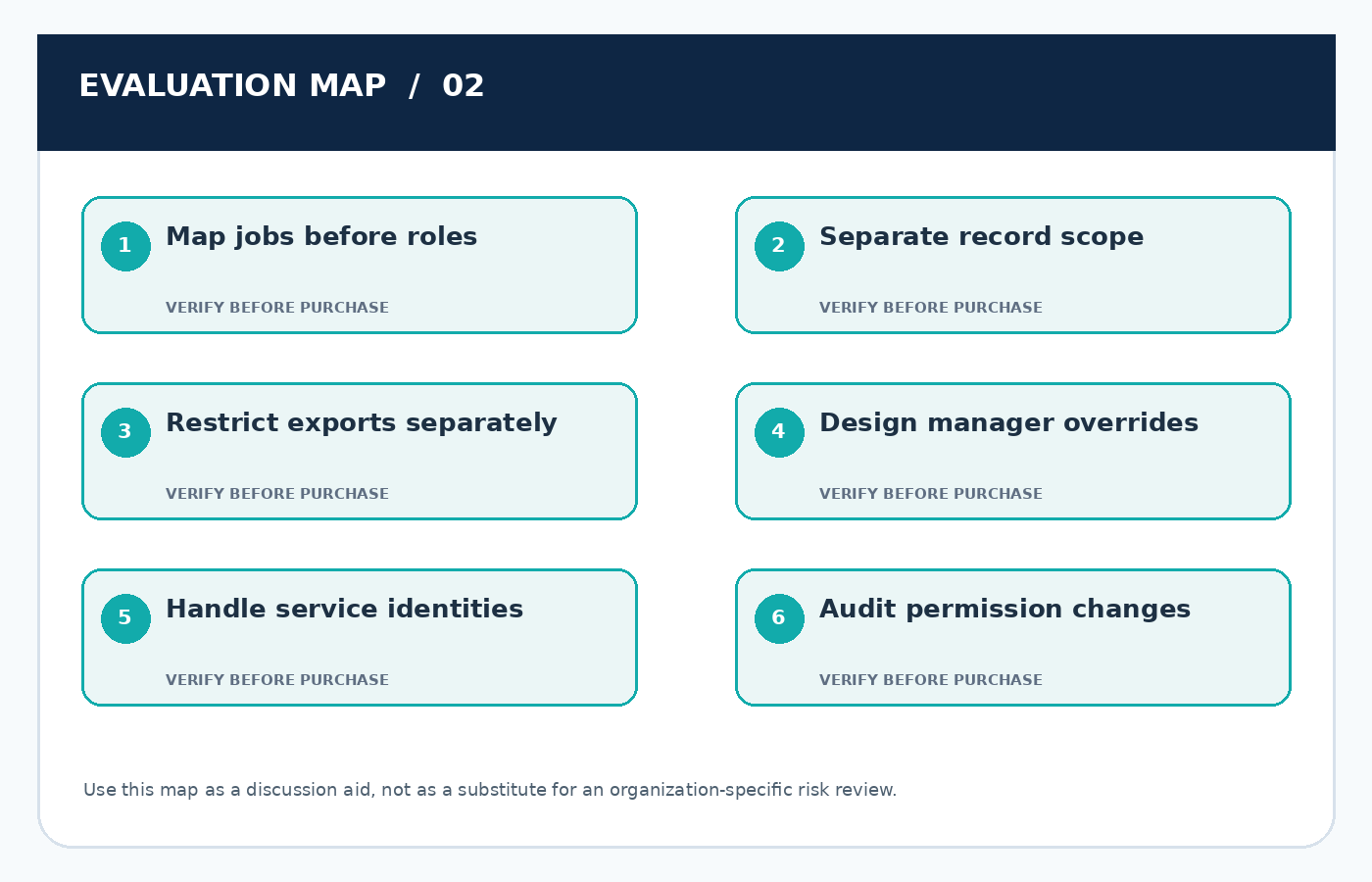
1. Map jobs before roles
Inventory day-to-day activities such as creating leads, changing pipeline stages, reviewing forecasts, approving discounts, and exporting mailing lists before opening the permission screen.
Failure to anticipate: Copying a vendor's default administrator profile onto a departmental manager quietly grants settings or deletion rights unrelated to the actual job.
Evidence to request: Interview each team leader for five representative tasks and classify each as read, create, update, assign, share, export, or administer.
2. Separate record scope
Territory, legal entity, account ownership, and support assignment may each require independent boundaries; access to a screen does not imply access to every row displayed there.
Failure to anticipate: A rep allowed to view all opportunities can inadvertently see sensitive negotiation notes from a competing client or another regional business unit.
Evidence to request: Create two imaginary customer accounts owned by different teams and test a user with access to only one; inspect search, reporting, exports, and mobile views.
3. Restrict exports separately
Bulk extraction and third-party sync offer a much larger exposure path than viewing a single record while doing sales work.
Failure to anticipate: The permission to build a campaign may be bundled with the ability to download the entire customer database, even for temporary external collaborators.
Evidence to request: Verify whether export, API access, list building, scheduled reports, and copy-to-spreadsheet workflows can be gated independently in the selected edition.
4. Design manager overrides
Supervisors may need aggregated pipeline reporting or emergency reassignment without unrestricted editing of confidential fields and records.
Failure to anticipate: Permanent all-access exceptions multiply over time and become invisible once staff reorganizations happen or project leads change.
Evidence to request: Specify a time-bound escalation path, name the approver, enable a record of the change, and require a review after the exceptional task concludes.
5. Handle service identities
A CRM integration is an identity too; its token often outlives the employee who originally configured it.
Failure to anticipate: Shared administrator credentials used for accounting or email automation undermine attribution and can break multiple processes during an otherwise routine password reset.
Evidence to request: Create named application credentials with minimum scopes, separate ownership documentation, token-expiration reminders, and a tested method to rotate secrets.
6. Audit permission changes
Configuration drift occurs as new objects, teams, and vendor add-ons create permissions that did not exist during the first role design.
Failure to anticipate: A quarterly review limited to employee names misses new permissions granted to a role that hundreds of existing users already inherit.
Evidence to request: Export both role definitions and user-to-role assignments, compare them with a documented baseline, and investigate any previously unapproved high-risk capability.
7. Include offboarding
Human resources, IT, and sales operations must agree who revokes access when staff leave, move roles, or work under short-term contracts.
Failure to anticipate: Suspending the login can leave active mobile sessions, API keys, shared inbox access, or delegated report subscriptions operational.
Evidence to request: Rehearse an imaginary termination: disable identity-provider access, invalidate vendor sessions where supported, transfer record ownership, and revoke connected accounts.
8. Consider exception handling
Some sales processes need cross-territory handoffs; use documented sharing rather than making the whole CRM public to avoid administrative friction.
Failure to anticipate: Unmanaged sharing links or permanently open project teams gradually create a second access model that nobody reviews.
Evidence to request: Maintain an exception register with business reason, permitted records, end date, and a named reviewer; include exceptions in recurring permission checks.
Procurement questions worth writing down
These questions translate the operational discussion into a decision record. Do not send them as an unexplained survey; ask the supplier to demonstrate answers in the actual subscription tier and have the business owner confirm the evidence.
- Map jobs before roles: Can the proposed capability be demonstrated with a fictional but realistic operating example rather than an idealized vendor dataset?
- Separate record scope: Who approves an exception, which evidence is retained, and what event triggers a review or revocation?
- Restrict exports separately: What additional edition, storage, implementation, or integration cost is required to make the promised capability operational?
- Design manager overrides: How would an employee notice that the control failed, and who is accountable for containment and correction?
- Handle service identities: Can the organization retrieve the relevant information and relationships in a usable format if it changes supplier?
- Audit permission changes: Which feature depends on another product or subprocessor, and how will material changes be communicated to the customer?
- Include offboarding: What task would staff complete during a vendor outage or a permission-related lockout?
- Consider exception handling: Which exact records, identities, or business events are within this requirement, and what is deliberately out of scope?
A realistic 90-day adoption plan
First 30 days: separate record scope
Create a simple register of customer record types, participants, and connected tools. Agree on a constrained example that represents ordinary work and a realistic exception. Review contractual boundaries and existing identity settings before trial data enters any external service. The focused activity in this phase concerns separate record scope; use an approved test record and retain the outcome for the rollout decision.
The checkpoint should include the decision owner, a clear pass-or-fail observation, and an agreed route to fix any unresolved issue. A planned launch date alone is not an acceptance criterion.
Days 31–60: handle service identities
Run permission, workflow, and data-flow tests using synthetic records. Capture screenshots or exportable audit evidence where permitted. Assign each finding to a named owner, separate blockers from improvements, and revise the proposed operating process rather than relying on informal fixes. The focused activity in this phase concerns handle service identities; use an approved test record and retain the outcome for the rollout decision.
The checkpoint should include the decision owner, a clear pass-or-fail observation, and an agreed route to fix any unresolved issue. A planned launch date alone is not an acceptance criterion.
Days 61–90: consider exception handling
Complete acceptance testing with actual job roles, rehearse a revocation or restore scenario, and establish the first access and vendor-review date. Keep a small decision log that records what was checked, which limitations remain, and why the selected workflow meets the organization’s requirements. The focused activity in this phase concerns consider exception handling; use an approved test record and retain the outcome for the rollout decision.
The checkpoint should include the decision owner, a clear pass-or-fail observation, and an agreed route to fix any unresolved issue. A planned launch date alone is not an acceptance criterion.
Frequently asked buyer questions
What should we validate before paying for a solution related to map jobs before roles?
Test a small, representative process with fictional records and obtain a written explanation of the service boundaries. The aim is to understand the exact purchased capability, the conditions under which it works, and whether it can be monitored by the customer after launch.
Which hidden risk tends to be overlooked in restrict exports separately?
The most common evaluation gap is treating the expected operating path as the only possible outcome. Include a negative test, agree on what a failure looks like, and name the individual who will investigate the exception rather than letting a supplier treat it as an edge case.
How can a small team conduct a meaningful trial without a large budget?
Concentrate on one workflow, a limited set of synthetic records, and staff who perform the job. A short, documented trial often produces better evidence than an extensive feature tour with no agreed success criteria. Protect sample information and document what would justify purchasing the next tier.
When should we reconsider the original buying decision?
Reopen the evaluation when the service boundary, pricing, team structure, data sensitivity, or business process changes significantly. Good stewardship is ongoing: the original procurement decision is not permanent authorization for every later use. Reassess unresolved risks and test that transition rights still work.
Official resources and further reading
These sources provide background principles and guidance. They do not endorse the fictional scenarios or certify a vendor mentioned in this article.
- Microsoft Dataverse: Role-Based Security
- NIST CSF 2.0 Small Business Quick-Start Guide
- FTC Cybersecurity for Small Business
Editorial conclusion
The right answer depends on workload, the value and sensitivity of the records, internal capacity, and the precise service terms. For crm role-based access control: designing permissions that match real teams, a defensible decision follows from the checks above and from an honest discussion of what cannot yet be demonstrated. Make unresolved questions visible, preserve a practical exit path, and recheck assumptions after the system becomes part of day-to-day work.
Related Posts
CRM Authentication Security: MFA, SSO, Sessions, and Account Recovery
How to protect a sales platform from stolen credentials while…
CRM Backup and Disaster Recovery: Testing Business Continuity
How to define recoverable CRM operations, validate exports, and avoid…
Secure CRM Data Migration: A Field-by-Field Transfer Plan
A migration procedure for protecting ownership, consent records, data quality,…