An integration security blueprint for protecting records while connecting CRM data to other business systems. This guide is written for a technical product owner connecting sales records with marketing automation, help desk, and accounting tools. It explains the tradeoffs a buyer can check without treating sales claims, product popularity, or advertising promises as independent evidence.
At the beginning of an evaluation, the most useful question is not which dashboard looks modern, but what the proposed process will actually require. For this subject, the central decision is specific: Treat every connector as a data-processing system with its own permissions, monitoring, and failure modes. The examples below are illustrative exercises, not claims that any named supplier has failed or passed an audit. Features, prices, data processing terms, and plan availability can change; verify the actual service before purchasing.
Begin with a decision the organization can defend
Consider the following representative situation: A technical product owner connecting sales records with marketing automation, help desk, and accounting tools. A selection meeting will be more useful if it establishes owners, measurable acceptance criteria, and the information the chosen service must protect. A product demonstration is a starting point for asking better questions; it should not replace a documented trial, a contract review, or a defined recovery route.
Treat every connector as a data-processing system with its own permissions, monitoring, and failure modes. Put this sentence at the top of the evaluation worksheet and ask each stakeholder to state which evidence would change their recommendation. That exercise prevents a conversation about attractive features from displacing practical questions about data handling, team adoption, business continuity, and responsibilities after launch.
Eight issues to evaluate in depth
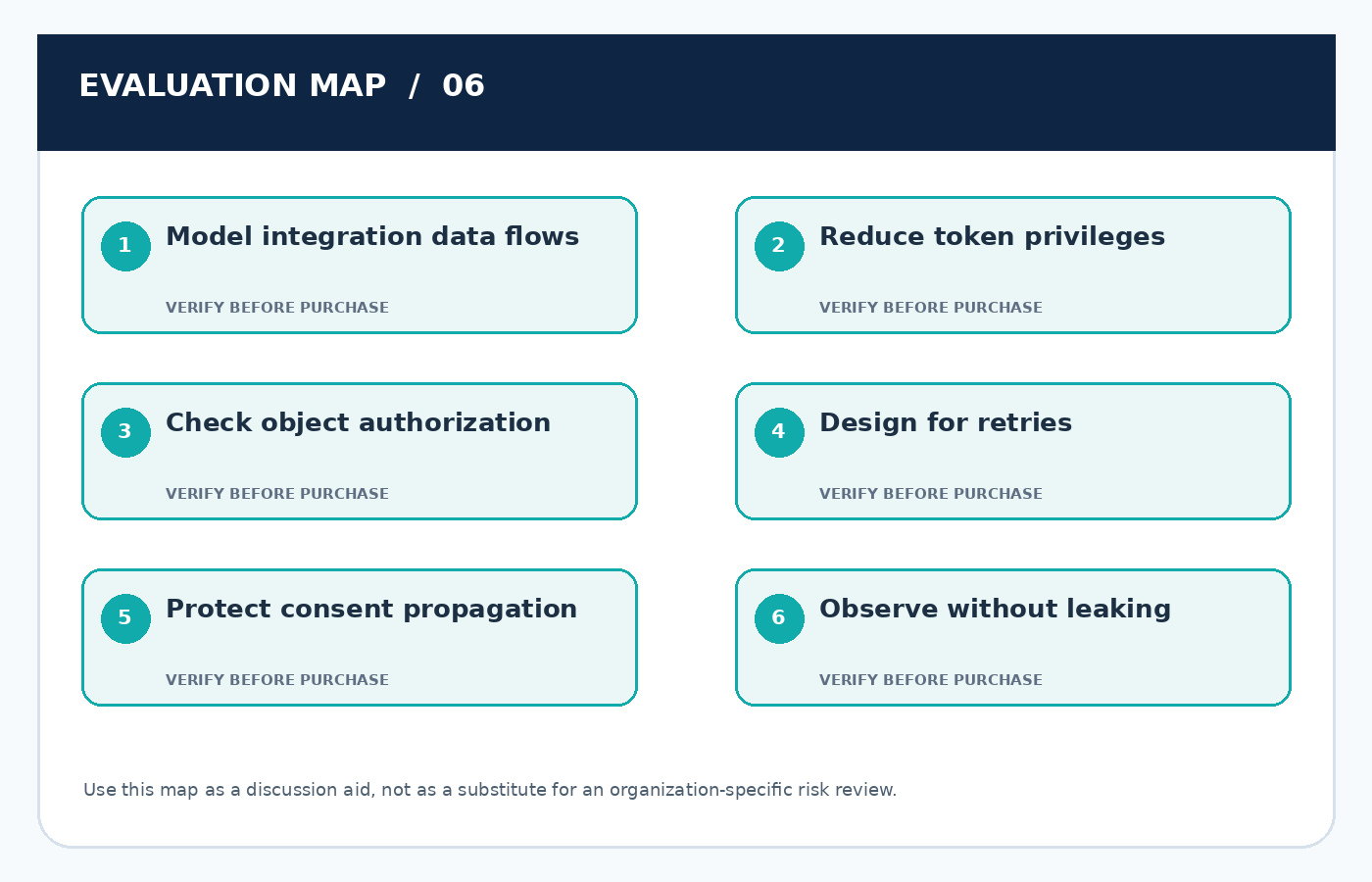
1. Model integration data flows
Draw the direction of each object and field between systems, including enrichment vendors, webhooks, email platforms, and scheduled CSV transfers.
Failure to anticipate: A diagram showing only a connector logo obscures whether a customer's private notes or suppression preferences are being copied to an external service.
Evidence to request: Create a field-level inventory, identify the source of truth, and record which organization can access the receiving system.
2. Reduce token privileges
An API credential should carry only the scopes needed by the task, with separate identities for development, reporting, and production processes.
Failure to anticipate: An all-access key copied into a low-code workflow can be exposed through a public log or reused to extract more records than the workflow requires.
Evidence to request: Review scopes, storage, expiration, rotation, environment separation, and whether secrets appear in deployment configurations or troubleshooting output.
3. Check object authorization
A valid login does not automatically authorize access to every account ID, deal, or customer-related attachment returned by an endpoint.
Failure to anticipate: If changing an identifier returns another team's record, an otherwise authenticated integration can violate the organization's access boundaries.
Evidence to request: Include negative tests for cross-team records and unauthorized properties, using OWASP's API security guidance as a risk-review aid.
4. Design for retries
Billing and contact events can arrive twice, out of order, or not at all because of network interruptions and queuing behavior.
Failure to anticipate: A naive webhook receiver may create duplicate invoices, reopen canceled opportunities, or overwrite the newest customer preference with an old update.
Evidence to request: Use idempotency keys where supported, timestamp checks, persistent failure queues, and a documented replay procedure with a maximum retry limit.
5. Protect consent propagation
Marketing permissions and suppression instructions require clear ownership and carefully designed event semantics across tools.
Failure to anticipate: A nightly synchronization that writes true over a more recent unsubscribe can trigger unwanted outreach despite correct settings in the origin application.
Evidence to request: Establish authoritative consent fields, precedence rules, timestamp handling, and a test in which an opt-out occurs during a delayed sync.
6. Observe without leaking
Operational logs should make failures diagnosable without becoming an uncontrolled secondary database of customer names, tokens, or message contents.
Failure to anticipate: Detailed debugging may store request bodies and bearer credentials in third-party logging products for months after the original incident.
Evidence to request: Redact tokens and high-risk fields, use request identifiers, restrict log viewers, and set appropriate retention and deletion procedures.
7. Prepare version changes
APIs evolve through endpoint deprecation, renamed fields, quota changes, and revised authentication requirements; unattended integrations degrade silently.
Failure to anticipate: A vendor update can stop invoice status from arriving while the dashboard continues to display stale sales information as if it were current.
Evidence to request: Track vendor notices, pin or test supported versions, establish error alerts, and rehearse a safe rollout in a nonproduction environment.
8. Retire old connections
Integration disposal must remove credentials, webhooks, scheduled jobs, dormant application users, and any stored customer copies.
Failure to anticipate: Simply uninstalling the visible CRM plugin may leave a third-party token active and a forgotten automation still exporting records.
Evidence to request: Keep a connector register and offboarding checklist that includes both endpoints, account owners, retained datasets, and revocation evidence.
Procurement questions worth writing down
These questions translate the operational discussion into a decision record. Do not send them as an unexplained survey; ask the supplier to demonstrate answers in the actual subscription tier and have the business owner confirm the evidence.
- Model integration data flows: Can the organization retrieve the relevant information and relationships in a usable format if it changes supplier?
- Reduce token privileges: Which feature depends on another product or subprocessor, and how will material changes be communicated to the customer?
- Check object authorization: What task would staff complete during a vendor outage or a permission-related lockout?
- Design for retries: Which exact records, identities, or business events are within this requirement, and what is deliberately out of scope?
- Protect consent propagation: Can the proposed capability be demonstrated with a fictional but realistic operating example rather than an idealized vendor dataset?
- Observe without leaking: Who approves an exception, which evidence is retained, and what event triggers a review or revocation?
- Prepare version changes: What additional edition, storage, implementation, or integration cost is required to make the promised capability operational?
- Retire old connections: How would an employee notice that the control failed, and who is accountable for containment and correction?
A realistic 90-day adoption plan
First 30 days: observe without leaking
Create a simple register of customer record types, participants, and connected tools. Agree on a constrained example that represents ordinary work and a realistic exception. Review contractual boundaries and existing identity settings before trial data enters any external service. The focused activity in this phase concerns observe without leaking; use an approved test record and retain the outcome for the rollout decision.
The checkpoint should include the decision owner, a clear pass-or-fail observation, and an agreed route to fix any unresolved issue. A planned launch date alone is not an acceptance criterion.
Days 31–60: model integration data flows
Run permission, workflow, and data-flow tests using synthetic records. Capture screenshots or exportable audit evidence where permitted. Assign each finding to a named owner, separate blockers from improvements, and revise the proposed operating process rather than relying on informal fixes. The focused activity in this phase concerns model integration data flows; use an approved test record and retain the outcome for the rollout decision.
The checkpoint should include the decision owner, a clear pass-or-fail observation, and an agreed route to fix any unresolved issue. A planned launch date alone is not an acceptance criterion.
Days 61–90: design for retries
Complete acceptance testing with actual job roles, rehearse a revocation or restore scenario, and establish the first access and vendor-review date. Keep a small decision log that records what was checked, which limitations remain, and why the selected workflow meets the organization’s requirements. The focused activity in this phase concerns design for retries; use an approved test record and retain the outcome for the rollout decision.
The checkpoint should include the decision owner, a clear pass-or-fail observation, and an agreed route to fix any unresolved issue. A planned launch date alone is not an acceptance criterion.
Frequently asked buyer questions
What should we validate before paying for a solution related to model integration data flows?
Test a small, representative process with fictional records and obtain a written explanation of the service boundaries. The aim is to understand the exact purchased capability, the conditions under which it works, and whether it can be monitored by the customer after launch.
Which hidden risk tends to be overlooked in check object authorization?
The most common evaluation gap is treating the expected operating path as the only possible outcome. Include a negative test, agree on what a failure looks like, and name the individual who will investigate the exception rather than letting a supplier treat it as an edge case.
How can a small team conduct a meaningful trial without a large budget?
Concentrate on one workflow, a limited set of synthetic records, and staff who perform the job. A short, documented trial often produces better evidence than an extensive feature tour with no agreed success criteria. Protect sample information and document what would justify purchasing the next tier.
When should we reconsider the original buying decision?
Reopen the evaluation when the service boundary, pricing, team structure, data sensitivity, or business process changes significantly. Good stewardship is ongoing: the original procurement decision is not permanent authorization for every later use. Reassess unresolved risks and test that transition rights still work.
Official resources and further reading
These sources provide background principles and guidance. They do not endorse the fictional scenarios or certify a vendor mentioned in this article.
- OWASP API Security Top 10 (2023)
- FTC Cybersecurity for Small Business
- NIST CSF 2.0 Small Business Quick-Start Guide
Editorial conclusion
The right answer depends on workload, the value and sensitivity of the records, internal capacity, and the precise service terms. For crm api security: safer integrations with email, billing, and marketing, a defensible decision follows from the checks above and from an honest discussion of what cannot yet be demonstrated. Make unresolved questions visible, preserve a practical exit path, and recheck assumptions after the system becomes part of day-to-day work.
Related Posts
CRM Authentication Security: MFA, SSO, Sessions, and Account Recovery
How to protect a sales platform from stolen credentials while…
CRM Privacy by Design: Consent, Retention, and Data Minimization
A practical way to govern customer information across lead capture,…
CRM Vendor Security Due Diligence: Questions Procurement Should Actually Ask
A purchase-ready evidence list that distinguishes meaningful assurance from attractive…