How to protect a sales platform from stolen credentials while keeping legitimate teams productive. This guide is written for an IT manager rolling out identity controls to employees, traveling salespeople, contractors, and administrators. It explains the tradeoffs a buyer can check without treating sales claims, product popularity, or advertising promises as independent evidence.
Better buying decisions emerge when operational requirements are written down before teams compare product tiers or agree to an implementation timeline. For this subject, the central decision is specific: Treat recovery and service accounts as first-class authentication decisions rather than afterthoughts. The examples below are illustrative exercises, not claims that any named supplier has failed or passed an audit. Features, prices, data processing terms, and plan availability can change; verify the actual service before purchasing.
Begin with a decision the organization can defend
Consider the following representative situation: An IT manager rolling out identity controls to employees, traveling salespeople, contractors, and administrators. A selection meeting will be more useful if it establishes owners, measurable acceptance criteria, and the information the chosen service must protect. A product demonstration is a starting point for asking better questions; it should not replace a documented trial, a contract review, or a defined recovery route.
Treat recovery and service accounts as first-class authentication decisions rather than afterthoughts. Put this sentence at the top of the evaluation worksheet and ask each stakeholder to state which evidence would change their recommendation. That exercise prevents a conversation about attractive features from displacing practical questions about data handling, team adoption, business continuity, and responsibilities after launch.
Eight issues to evaluate in depth
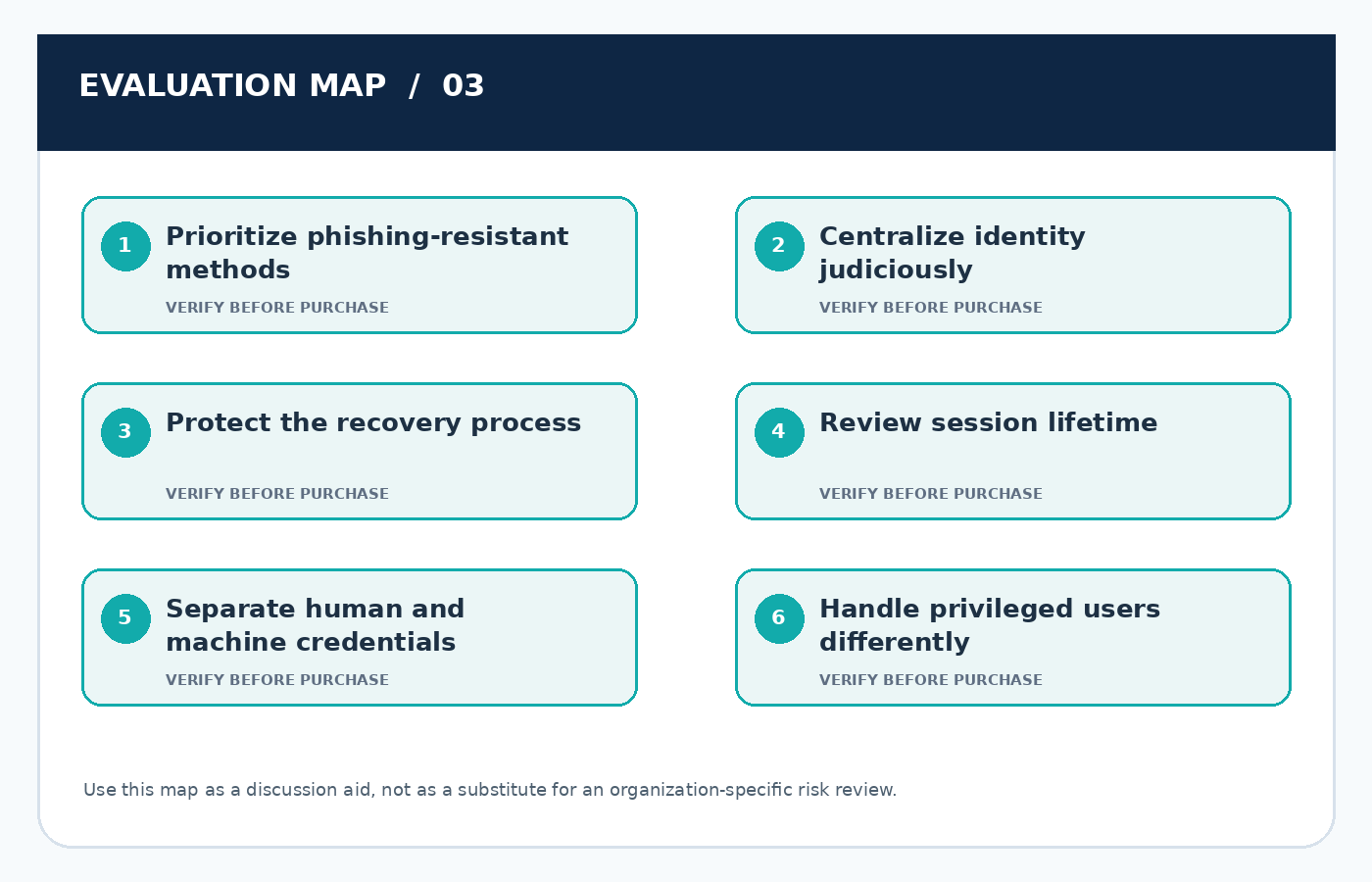
1. Prioritize phishing-resistant methods
Multifactor authentication changes the consequences of password theft, but methods differ in their resistance to impostor login pages and session interception.
Failure to anticipate: A rushed rollout can leave the administrator relying on a weaker recovery path or an unchecked fallback method available to attackers.
Evidence to request: Inventory supported authenticators, prioritize stronger methods such as security keys or passkeys when offered, and test recovery with a designated backup administrator.
2. Centralize identity judiciously
Single sign-on can make onboarding and termination more consistent when linked to a maintained directory and reliable group assignments.
Failure to anticipate: SSO is not a security guarantee if local CRM passwords remain active, administrators lack MFA, or the team loses access during an identity-provider outage.
Evidence to request: Compare direct vendor login with identity-provider login, document break-glass conditions, and confirm which tenant settings actually enforce the preferred route.
3. Protect the recovery process
Lost phones, employee travel, and team changes create legitimate recovery requests that resemble social-engineering attempts.
Failure to anticipate: A help desk agent who accepts an unverified email or urgent phone call may override stronger authentication controls in minutes.
Evidence to request: Define acceptable identity checks, second-person approval for privileged accounts, recovery logging, and a follow-up notice to the account owner.
4. Review session lifetime
Sessions affect both customer-data exposure and the practicality of field sales or mobile device use across long working days.
Failure to anticipate: A former contractor can retain an active token or browser session even after someone changes the password, depending on platform behavior.
Evidence to request: Test logout from all devices, administrative revocation, idle timeout, session visibility, and mobile app behavior under ordinary and compromised-account scenarios.
5. Separate human and machine credentials
Email sync, marketing automation, and reporting services may need noninteractive access that should not depend on one employee's personal login.
Failure to anticipate: Connecting every integration with a privileged human account obscures responsibility and may create service outages when that person leaves.
Evidence to request: Request dedicated service-identity support, least-privilege API scopes, log attribution, key rotation, and documented ownership for every connector.
6. Handle privileged users differently
Tenant owners and security administrators have the capacity to alter audit settings, export datasets, or change identity controls for everyone.
Failure to anticipate: A single standing super-admin, protected only by the same mechanisms as ordinary users, becomes a particularly valuable target.
Evidence to request: Maintain separate privileged identities where practical, minimize their count, audit exceptional actions, and require additional verification for recovery or elevation.
7. Train against approval fatigue
Staff must understand why authentication prompts appear and what to do when a notification arrives during a meeting they did not initiate.
Failure to anticipate: Repeated unexpected approvals may be accepted reflexively, especially when instructions frame every authentication prompt as routine housekeeping.
Evidence to request: Give employees a simple deny-and-report channel and verify the response process with tabletop exercises rather than measuring success only by training completion.
8. Plan rollout by cohort
Authentication changes can interrupt legitimate work if shared devices, temporary staff, and traveling sales personnel are not included in the pilot.
Failure to anticipate: Enabling a tenant-wide mandatory rule before testing delegated calendars or mobile phones can create disruption and tempt administrators to disable protections.
Evidence to request: Pilot with a small mixed group, document failure modes, stage policy enforcement, and retain a controlled emergency access procedure.
Procurement questions worth writing down
These questions translate the operational discussion into a decision record. Do not send them as an unexplained survey; ask the supplier to demonstrate answers in the actual subscription tier and have the business owner confirm the evidence.
- Prioritize phishing-resistant methods: Who approves an exception, which evidence is retained, and what event triggers a review or revocation?
- Centralize identity judiciously: What additional edition, storage, implementation, or integration cost is required to make the promised capability operational?
- Protect the recovery process: How would an employee notice that the control failed, and who is accountable for containment and correction?
- Review session lifetime: Can the organization retrieve the relevant information and relationships in a usable format if it changes supplier?
- Separate human and machine credentials: Which feature depends on another product or subprocessor, and how will material changes be communicated to the customer?
- Handle privileged users differently: What task would staff complete during a vendor outage or a permission-related lockout?
- Train against approval fatigue: Which exact records, identities, or business events are within this requirement, and what is deliberately out of scope?
- Plan rollout by cohort: Can the proposed capability be demonstrated with a fictional but realistic operating example rather than an idealized vendor dataset?
A realistic 90-day adoption plan
First 30 days: protect the recovery process
Create a simple register of customer record types, participants, and connected tools. Agree on a constrained example that represents ordinary work and a realistic exception. Review contractual boundaries and existing identity settings before trial data enters any external service. The focused activity in this phase concerns protect the recovery process; use an approved test record and retain the outcome for the rollout decision.
The checkpoint should include the decision owner, a clear pass-or-fail observation, and an agreed route to fix any unresolved issue. A planned launch date alone is not an acceptance criterion.
Days 31–60: handle privileged users differently
Run permission, workflow, and data-flow tests using synthetic records. Capture screenshots or exportable audit evidence where permitted. Assign each finding to a named owner, separate blockers from improvements, and revise the proposed operating process rather than relying on informal fixes. The focused activity in this phase concerns handle privileged users differently; use an approved test record and retain the outcome for the rollout decision.
The checkpoint should include the decision owner, a clear pass-or-fail observation, and an agreed route to fix any unresolved issue. A planned launch date alone is not an acceptance criterion.
Days 61–90: prioritize phishing-resistant methods
Complete acceptance testing with actual job roles, rehearse a revocation or restore scenario, and establish the first access and vendor-review date. Keep a small decision log that records what was checked, which limitations remain, and why the selected workflow meets the organization’s requirements. The focused activity in this phase concerns prioritize phishing-resistant methods; use an approved test record and retain the outcome for the rollout decision.
The checkpoint should include the decision owner, a clear pass-or-fail observation, and an agreed route to fix any unresolved issue. A planned launch date alone is not an acceptance criterion.
Frequently asked buyer questions
What should we validate before paying for a solution related to prioritize phishing-resistant methods?
Test a small, representative process with fictional records and obtain a written explanation of the service boundaries. The aim is to understand the exact purchased capability, the conditions under which it works, and whether it can be monitored by the customer after launch.
Which hidden risk tends to be overlooked in protect the recovery process?
The most common evaluation gap is treating the expected operating path as the only possible outcome. Include a negative test, agree on what a failure looks like, and name the individual who will investigate the exception rather than letting a supplier treat it as an edge case.
How can a small team conduct a meaningful trial without a large budget?
Concentrate on one workflow, a limited set of synthetic records, and staff who perform the job. A short, documented trial often produces better evidence than an extensive feature tour with no agreed success criteria. Protect sample information and document what would justify purchasing the next tier.
When should we reconsider the original buying decision?
Reopen the evaluation when the service boundary, pricing, team structure, data sensitivity, or business process changes significantly. Good stewardship is ongoing: the original procurement decision is not permanent authorization for every later use. Reassess unresolved risks and test that transition rights still work.
Official resources and further reading
These sources provide background principles and guidance. They do not endorse the fictional scenarios or certify a vendor mentioned in this article.
- NIST CSF 2.0 Small Business Quick-Start Guide
- FTC Cybersecurity for Small Business
- Microsoft Dataverse: Role-Based Security
Editorial conclusion
The right answer depends on workload, the value and sensitivity of the records, internal capacity, and the precise service terms. For crm authentication security: mfa, sso, sessions, and account recovery, a defensible decision follows from the checks above and from an honest discussion of what cannot yet be demonstrated. Make unresolved questions visible, preserve a practical exit path, and recheck assumptions after the system becomes part of day-to-day work.
Related Posts
Healthcare CRM Security: Evaluating HIPAA-Relevant Workflows
A careful buying and configuration guide for healthcare organizations handling…
CRM Vendor Security Due Diligence: Questions Procurement Should Actually Ask
A purchase-ready evidence list that distinguishes meaningful assurance from attractive…
AI Features in CRM: Security, Accuracy, and Human Oversight
How to evaluate AI summaries, lead scores, writing assistants, and…