A careful buying and configuration guide for healthcare organizations handling protected information in customer-facing software. This guide is written for an administrator at a U.S. healthcare organization assessing scheduling, relationship management, and outreach workflows. It explains the tradeoffs a buyer can check without treating sales claims, product popularity, or advertising promises as independent evidence.
The challenge is to make controls usable in real work: staff need an accountable method, not a promise that a vendor will solve every problem automatically. For this subject, the central decision is specific: Avoid labels such as HIPAA certified; compliance depends on actual use, contracts, safeguards, and legal analysis. The examples below are illustrative exercises, not claims that any named supplier has failed or passed an audit. Features, prices, data processing terms, and plan availability can change; verify the actual service before purchasing.
Begin with a decision the organization can defend
Consider the following representative situation: An administrator at a U.S. healthcare organization assessing scheduling, relationship management, and outreach workflows. A selection meeting will be more useful if it establishes owners, measurable acceptance criteria, and the information the chosen service must protect. A product demonstration is a starting point for asking better questions; it should not replace a documented trial, a contract review, or a defined recovery route.
Avoid labels such as HIPAA certified; compliance depends on actual use, contracts, safeguards, and legal analysis. Put this sentence at the top of the evaluation worksheet and ask each stakeholder to state which evidence would change their recommendation. That exercise prevents a conversation about attractive features from displacing practical questions about data handling, team adoption, business continuity, and responsibilities after launch.
Eight issues to evaluate in depth
1. Classify proposed records
A CRM used for general vendor relations is not the same as a tool containing patient records, appointment details, intake notes, or other potentially protected health information.
Failure to anticipate: Buyers may select a low-cost generic subscription before realizing staff intend to store identifiable clinical context in free-text fields.
Evidence to request: Map exactly what information enters the system, who supplies it, its intended use, and whether qualified privacy counsel identifies it as PHI.
2. Check business associate obligations
Where a cloud provider creates, receives, maintains, or transmits electronic protected health information on behalf of a regulated organization, HHS guidance addresses business associate responsibilities.
Failure to anticipate: Advertising language describing a product as healthcare-ready does not replace an appropriate business associate agreement or the organization's own risk assessment.
Evidence to request: Confirm whether the specific service and features are covered by an applicable BAA and examine permitted uses, disclosures, safeguards, and subcontractor arrangements.
3. Minimize clinical context
Relationship management does not automatically require diagnoses, insurance identifiers, or treatment histories to perform every scheduling or communication task.
Failure to anticipate: Sensitive details in an unrestricted timeline can be displayed in dashboards, exported to marketing applications, or copied into AI features without appropriate controls.
Evidence to request: Use purpose-specific fields, restricted access, clear staff guidance, and an approved process for information that belongs in a clinical system instead.
4. Evaluate access detail
Medical organizations need to decide which roles can see a referral, edit a contact, perform administrative exports, or view a message containing patient information.
Failure to anticipate: Generic sales team permissions may make every customer profile available to marketing staff and third-party contractors inappropriately.
Evidence to request: Build role and record-scope tests using synthetic patients and staff personas; verify exported reports, mobile access, service identities, and support impersonation.
5. Review communications workflows
Appointment reminders, newsletters, portal messages, and referrals may use distinct systems and channel policies; the CRM should not blur their intended purposes.
Failure to anticipate: A general campaign feature may inadvertently send sensitive context to an incorrect address, a shared device, or an unauthorized vendor.
Evidence to request: Approve templates and recipients with the relevant team, minimize disclosed content, and document when secure channels or additional agreements are required.
6. Demand recovery capabilities
Healthcare continuity depends on reliable access, incident response, and a clear return-of-data procedure, not merely a vendor's marketing statement about uptime.
Failure to anticipate: An encrypted export stored without controlled access or a usable restore process can undermine both privacy and operational resilience.
Evidence to request: Examine service terms, retention and deletion provisions, test recovery procedures, breach-notification processes, and documented internal contingency plans.
7. Understand AI feature boundaries
AI summarization and prediction may send additional data to separate services or enable defaults that are unsuitable for the proposed use case.
Failure to anticipate: Staff may paste patient conversations into an assistant without understanding the feature's approved inputs, retention, or contractual coverage.
Evidence to request: Obtain written details about model-related processing, subcontractors, opt-outs, human review, and which features are expressly included within authorized agreements.
8. Keep the decision documented
Regulatory obligations can vary with the organization, records, jurisdictions, and the actual operations performed; software selection alone cannot establish compliance.
Failure to anticipate: A procurement team that equates a vendor badge with full legal compliance may skip staff training, risk assessment, breach response, or contractual review.
Evidence to request: Maintain a signed decision file containing use cases, risk analysis, contracts, test evidence, legal review, and outstanding control owners.
Procurement questions worth writing down
These questions translate the operational discussion into a decision record. Do not send them as an unexplained survey; ask the supplier to demonstrate answers in the actual subscription tier and have the business owner confirm the evidence.
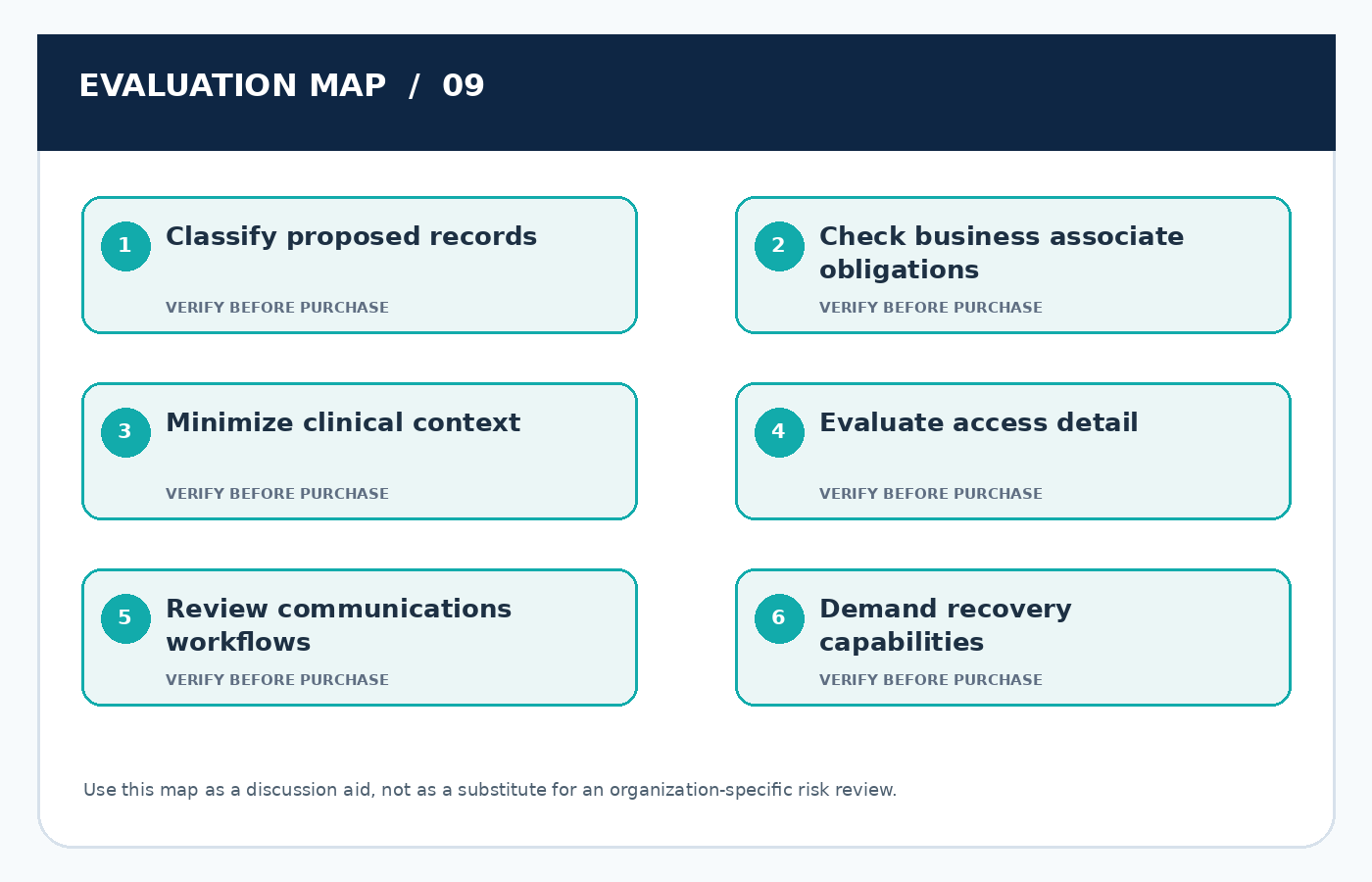
- Classify proposed records: Which exact records, identities, or business events are within this requirement, and what is deliberately out of scope?
- Check business associate obligations: Can the proposed capability be demonstrated with a fictional but realistic operating example rather than an idealized vendor dataset?
- Minimize clinical context: Who approves an exception, which evidence is retained, and what event triggers a review or revocation?
- Evaluate access detail: What additional edition, storage, implementation, or integration cost is required to make the promised capability operational?
- Review communications workflows: How would an employee notice that the control failed, and who is accountable for containment and correction?
- Demand recovery capabilities: Can the organization retrieve the relevant information and relationships in a usable format if it changes supplier?
- Understand AI feature boundaries: Which feature depends on another product or subprocessor, and how will material changes be communicated to the customer?
- Keep the decision documented: What task would staff complete during a vendor outage or a permission-related lockout?
A realistic 90-day adoption plan
First 30 days: classify proposed records
Create a simple register of customer record types, participants, and connected tools. Agree on a constrained example that represents ordinary work and a realistic exception. Review contractual boundaries and existing identity settings before trial data enters any external service. The focused activity in this phase concerns classify proposed records; use an approved test record and retain the outcome for the rollout decision.
The checkpoint should include the decision owner, a clear pass-or-fail observation, and an agreed route to fix any unresolved issue. A planned launch date alone is not an acceptance criterion.
Days 31–60: evaluate access detail
Run permission, workflow, and data-flow tests using synthetic records. Capture screenshots or exportable audit evidence where permitted. Assign each finding to a named owner, separate blockers from improvements, and revise the proposed operating process rather than relying on informal fixes. The focused activity in this phase concerns evaluate access detail; use an approved test record and retain the outcome for the rollout decision.
The checkpoint should include the decision owner, a clear pass-or-fail observation, and an agreed route to fix any unresolved issue. A planned launch date alone is not an acceptance criterion.
Days 61–90: understand ai feature boundaries
Complete acceptance testing with actual job roles, rehearse a revocation or restore scenario, and establish the first access and vendor-review date. Keep a small decision log that records what was checked, which limitations remain, and why the selected workflow meets the organization’s requirements. The focused activity in this phase concerns understand ai feature boundaries; use an approved test record and retain the outcome for the rollout decision.
The checkpoint should include the decision owner, a clear pass-or-fail observation, and an agreed route to fix any unresolved issue. A planned launch date alone is not an acceptance criterion.
Frequently asked buyer questions
What should we validate before paying for a solution related to classify proposed records?
Test a small, representative process with fictional records and obtain a written explanation of the service boundaries. The aim is to understand the exact purchased capability, the conditions under which it works, and whether it can be monitored by the customer after launch.
Which hidden risk tends to be overlooked in minimize clinical context?
The most common evaluation gap is treating the expected operating path as the only possible outcome. Include a negative test, agree on what a failure looks like, and name the individual who will investigate the exception rather than letting a supplier treat it as an edge case.
How can a small team conduct a meaningful trial without a large budget?
Concentrate on one workflow, a limited set of synthetic records, and staff who perform the job. A short, documented trial often produces better evidence than an extensive feature tour with no agreed success criteria. Protect sample information and document what would justify purchasing the next tier.
When should we reconsider the original buying decision?
Reopen the evaluation when the service boundary, pricing, team structure, data sensitivity, or business process changes significantly. Good stewardship is ongoing: the original procurement decision is not permanent authorization for every later use. Reassess unresolved risks and test that transition rights still work.
Official resources and further reading
These sources provide background principles and guidance. They do not endorse the fictional scenarios or certify a vendor mentioned in this article.
- HHS Guidance on HIPAA and Cloud Computing
- NIST CSF 2.0 Small Business Quick-Start Guide
- FTC Cybersecurity for Small Business
Editorial conclusion
The right answer depends on workload, the value and sensitivity of the records, internal capacity, and the precise service terms. For healthcare crm security: evaluating hipaa-relevant workflows, a defensible decision follows from the checks above and from an honest discussion of what cannot yet be demonstrated. Make unresolved questions visible, preserve a practical exit path, and recheck assumptions after the system becomes part of day-to-day work.
Related Posts
CRM Vendor Security Due Diligence: Questions Procurement Should Actually Ask
A purchase-ready evidence list that distinguishes meaningful assurance from attractive…
CRM Authentication Security: MFA, SSO, Sessions, and Account Recovery
How to protect a sales platform from stolen credentials while…
Secure CRM Data Migration: A Field-by-Field Transfer Plan
A migration procedure for protecting ownership, consent records, data quality,…