A purchase-ready evidence list that distinguishes meaningful assurance from attractive but incomplete security claims. This guide is written for a procurement committee evaluating competing CRM proposals with IT, legal, and revenue operations involved. It explains the tradeoffs a buyer can check without treating sales claims, product popularity, or advertising promises as independent evidence.
The challenge is to make controls usable in real work: staff need an accountable method, not a promise that a vendor will solve every problem automatically. For this subject, the central decision is specific: Require evidence tied to the precise service and contract being bought, not a generic security slide deck. The examples below are illustrative exercises, not claims that any named supplier has failed or passed an audit. Features, prices, data processing terms, and plan availability can change; verify the actual service before purchasing.
Begin with a decision the organization can defend
Consider the following representative situation: A procurement committee evaluating competing CRM proposals with IT, legal, and revenue operations involved. A selection meeting will be more useful if it establishes owners, measurable acceptance criteria, and the information the chosen service must protect. A product demonstration is a starting point for asking better questions; it should not replace a documented trial, a contract review, or a defined recovery route.
Require evidence tied to the precise service and contract being bought, not a generic security slide deck. Put this sentence at the top of the evaluation worksheet and ask each stakeholder to state which evidence would change their recommendation. That exercise prevents a conversation about attractive features from displacing practical questions about data handling, team adoption, business continuity, and responsibilities after launch.
Eight issues to evaluate in depth
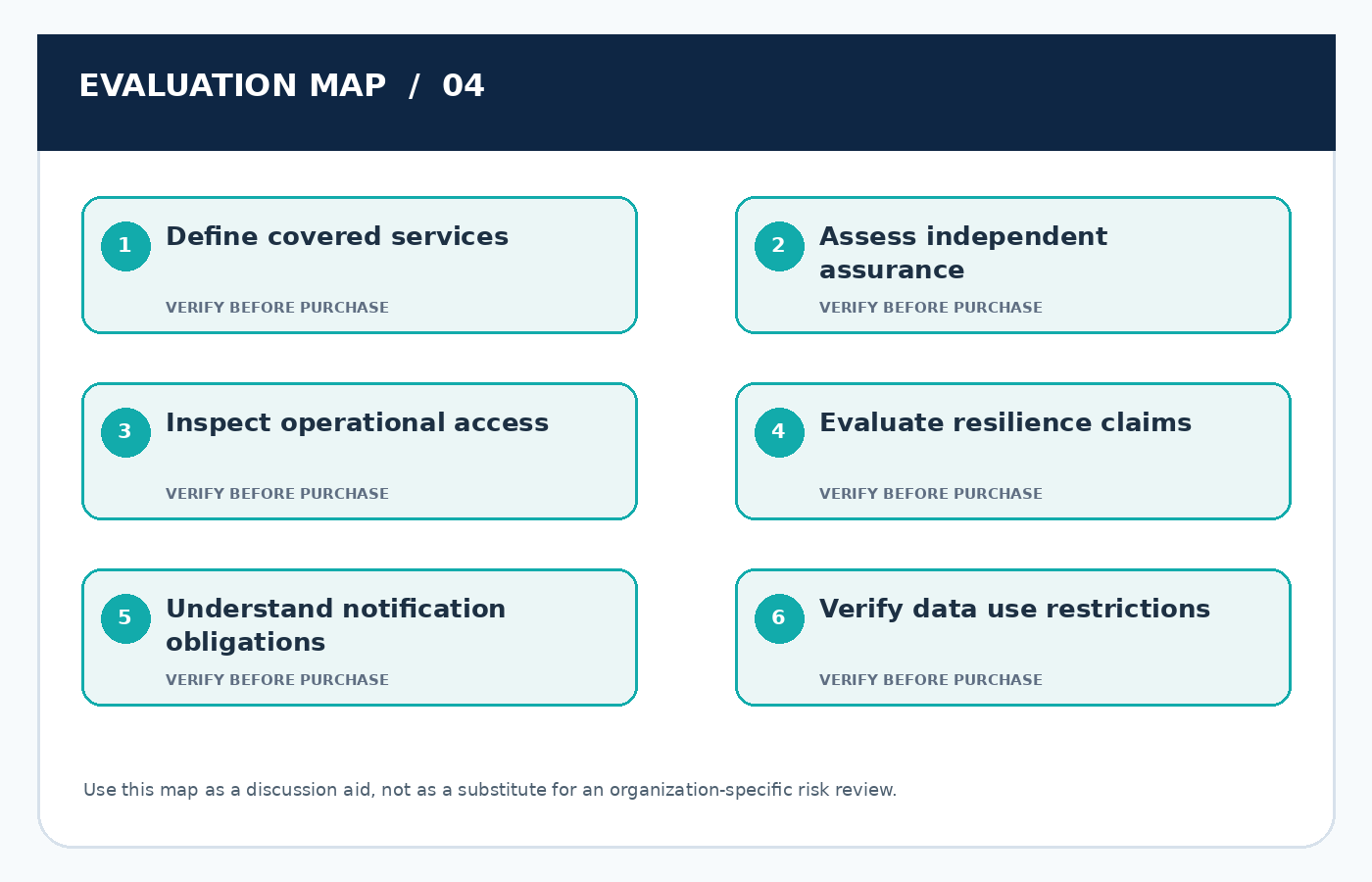
1. Define covered services
Establish whether the security response includes production CRM, support access, mobile apps, analytics modules, integrated AI services, and all connected subprocessors.
Failure to anticipate: A vendor's assurance may refer to an infrastructure host while excluding the application layer or the third-party feature on which the company depends.
Evidence to request: Ask for an explicit service boundary, a current architecture overview, and the names of entities handling identifiable customer information.
2. Assess independent assurance
Reports and certifications can support diligence when current, scoped appropriately, and accompanied by a discussion of exceptions or remediation.
Failure to anticipate: Merely displaying an audit badge does not prove every feature or data center used by the customer was within that review's scope.
Evidence to request: Request relevant report dates, coverage, bridge letters where appropriate, and management responses to significant observations under an appropriate confidentiality arrangement.
3. Inspect operational access
Provider employees may need limited support access to troubleshoot accounts, restore services, or resolve a billing issue.
Failure to anticipate: Vague claims about trained staff do not explain who can open customer records, when access is logged, or how extraordinary access is approved.
Evidence to request: Ask the provider to describe support impersonation, privileged access controls, access review cadence, and whether customers receive meaningful activity records.
4. Evaluate resilience claims
Security purchasing must also address the availability and integrity of records after operator error, malicious deletion, or a vendor-side incident.
Failure to anticipate: A generic daily-backup statement says little about restore granularity, recovery timing, backup isolation, or whose request authorizes restoration.
Evidence to request: Request recovery objective definitions, recent test evidence, retention parameters, and the process for restoring a sample deleted account without replacing unrelated records.
5. Understand notification obligations
The contract should clarify how the supplier identifies, contains, investigates, and communicates incidents affecting customer data.
Failure to anticipate: A notification promise that begins only after final legal confirmation may leave customers unable to meet their own time-sensitive obligations.
Evidence to request: Ask for notification triggers, contacts, update frequency, required information, evidence preservation, and alignment with applicable contractual or legal requirements.
6. Verify data use restrictions
CRM notes and interactions may be valuable to analytics or AI development, so customers should know exactly what processing is optional and what cannot be disabled.
Failure to anticipate: Broad contractual language may permit unexpected downstream processing or indefinite retention after the customer exports and closes an account.
Evidence to request: Compare the privacy notice, data processing terms, AI feature settings, subprocessor list, deletion timetable, and customer opt-out mechanisms.
7. Examine change management
New product features, acquired services, pricing tiers, and connected apps can materially alter the initial risk assessment during a long contract.
Failure to anticipate: A one-time questionnaire becomes stale when material subprocessors or control responsibilities change but no buyer receives notice.
Evidence to request: Negotiate practical notice periods, review rights for material changes, and a named owner who reopens the diligence file after significant platform updates.
8. Plan contractual exit
A secure relationship must end cleanly, with understandable export formats, assistance terms, deletion procedures, and continuity until transition completes.
Failure to anticipate: Vendors may offer export only at premium rates or remove account access before files and relationships have been verified elsewhere.
Evidence to request: Obtain written details on export scope, time allowed after termination, customer-held backup responsibilities, deletion confirmation, and assistance pricing.
Procurement questions worth writing down
These questions translate the operational discussion into a decision record. Do not send them as an unexplained survey; ask the supplier to demonstrate answers in the actual subscription tier and have the business owner confirm the evidence.
- Define covered services: What additional edition, storage, implementation, or integration cost is required to make the promised capability operational?
- Assess independent assurance: How would an employee notice that the control failed, and who is accountable for containment and correction?
- Inspect operational access: Can the organization retrieve the relevant information and relationships in a usable format if it changes supplier?
- Evaluate resilience claims: Which feature depends on another product or subprocessor, and how will material changes be communicated to the customer?
- Understand notification obligations: What task would staff complete during a vendor outage or a permission-related lockout?
- Verify data use restrictions: Which exact records, identities, or business events are within this requirement, and what is deliberately out of scope?
- Examine change management: Can the proposed capability be demonstrated with a fictional but realistic operating example rather than an idealized vendor dataset?
- Plan contractual exit: Who approves an exception, which evidence is retained, and what event triggers a review or revocation?
A realistic 90-day adoption plan
First 30 days: evaluate resilience claims
Create a simple register of customer record types, participants, and connected tools. Agree on a constrained example that represents ordinary work and a realistic exception. Review contractual boundaries and existing identity settings before trial data enters any external service. The focused activity in this phase concerns evaluate resilience claims; use an approved test record and retain the outcome for the rollout decision.
The checkpoint should include the decision owner, a clear pass-or-fail observation, and an agreed route to fix any unresolved issue. A planned launch date alone is not an acceptance criterion.
Days 31–60: examine change management
Run permission, workflow, and data-flow tests using synthetic records. Capture screenshots or exportable audit evidence where permitted. Assign each finding to a named owner, separate blockers from improvements, and revise the proposed operating process rather than relying on informal fixes. The focused activity in this phase concerns examine change management; use an approved test record and retain the outcome for the rollout decision.
The checkpoint should include the decision owner, a clear pass-or-fail observation, and an agreed route to fix any unresolved issue. A planned launch date alone is not an acceptance criterion.
Days 61–90: assess independent assurance
Complete acceptance testing with actual job roles, rehearse a revocation or restore scenario, and establish the first access and vendor-review date. Keep a small decision log that records what was checked, which limitations remain, and why the selected workflow meets the organization’s requirements. The focused activity in this phase concerns assess independent assurance; use an approved test record and retain the outcome for the rollout decision.
The checkpoint should include the decision owner, a clear pass-or-fail observation, and an agreed route to fix any unresolved issue. A planned launch date alone is not an acceptance criterion.
Frequently asked buyer questions
What should we validate before paying for a solution related to define covered services?
Test a small, representative process with fictional records and obtain a written explanation of the service boundaries. The aim is to understand the exact purchased capability, the conditions under which it works, and whether it can be monitored by the customer after launch.
Which hidden risk tends to be overlooked in inspect operational access?
The most common evaluation gap is treating the expected operating path as the only possible outcome. Include a negative test, agree on what a failure looks like, and name the individual who will investigate the exception rather than letting a supplier treat it as an edge case.
How can a small team conduct a meaningful trial without a large budget?
Concentrate on one workflow, a limited set of synthetic records, and staff who perform the job. A short, documented trial often produces better evidence than an extensive feature tour with no agreed success criteria. Protect sample information and document what would justify purchasing the next tier.
When should we reconsider the original buying decision?
Reopen the evaluation when the service boundary, pricing, team structure, data sensitivity, or business process changes significantly. Good stewardship is ongoing: the original procurement decision is not permanent authorization for every later use. Reassess unresolved risks and test that transition rights still work.
Official resources and further reading
These sources provide background principles and guidance. They do not endorse the fictional scenarios or certify a vendor mentioned in this article.
- FTC Cybersecurity for Small Business
- NIST CSF 2.0 Small Business Quick-Start Guide
- FTC Data Breach Response: A Guide for Business
Editorial conclusion
The right answer depends on workload, the value and sensitivity of the records, internal capacity, and the precise service terms. For crm vendor security due diligence: questions procurement should actually ask, a defensible decision follows from the checks above and from an honest discussion of what cannot yet be demonstrated. Make unresolved questions visible, preserve a practical exit path, and recheck assumptions after the system becomes part of day-to-day work.
Related Posts
CRM Privacy by Design: Consent, Retention, and Data Minimization
A practical way to govern customer information across lead capture,…

How to Choose a Secure CRM: A Buyer’s Evaluation Framework
A procurement framework for balancing sales usability, ownership of customer…
CRM Authentication Security: MFA, SSO, Sessions, and Account Recovery
How to protect a sales platform from stolen credentials while…